Retinol After 45: How to Choose It Without Wrecking Your Skin Barrier (A Friend-to-Friend Guide)
A realistic retinol guide for women 45+: how to choose the right strength, “sandwich” method, what to avoid mixing, a recovery plan for irritation, and SPF rules that actually protect your results.
MATURE BEAUTY GUIDE
2/22/20267 min read
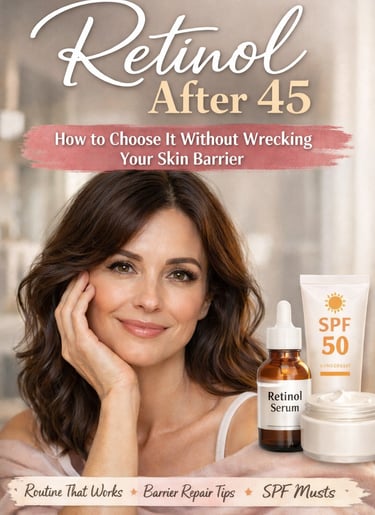
Let me start with the thing I wish someone had told me at 45:
Retinol isn’t “hard.”
Recovering from using retinol the wrong way is hard.
My first attempt was… enthusiastic. I used it too often, expected a glow in a week, and ended up with that tight, shiny, irritated look that makes makeup cling in the worst possible way. I thought my skin was “failing.” In reality, my routine was failing my skin.
So if you’re curious about retinol (or you’ve already tried and quit), this guide is for you. We’re going to do it like grown women: slow, consistent, barrier-friendly, and SPF-first.
(Quick note: I’m not a dermatologist. This is what worked for me + what’s generally recommended. Patch test, go slowly, and if you’re pregnant/breastfeeding or using prescription treatments, check with your doctor.)
The Retinol Truth After 45 (No Drama, Just Reality)
After 45, many of us notice the same pattern:
skin feels drier more easily
the barrier gets stressed faster
we’re more likely to get redness/flake patches
recovery takes longer than it did at 30
So the goal isn’t “the strongest retinol.”
The goal is the strongest retinol your skin can tolerate consistently.
Because retinol results come from repetition, not bravery.
Step 1: Choose Your Retinoid Like a Grown Woman (Not Like TikTok)
Here’s the simplest way to think about retinoids:
Retinol (common, beginner-friendly)
Needs conversion in the skin → tends to be gentler than prescription forms
Great for beginners if you start slow
Retinal / Retinaldehyde (often stronger than retinol)
Converts in fewer steps → can work faster
Can also irritate more if you rush it
Adapalene (often used for acne; OTC in some places)
Different retinoid category
Some people tolerate it well, others find it drying
Prescription tretinoin/tazarotene
Effective, but more likely to irritate without a supportive routine
Not the best “first ever” step if your barrier is fragile
Friend advice: If you’re new to retinoids at 45+, don’t start with the harshest option “to save time.”
That’s usually how you end up taking a month off and losing momentum.
Step 2: Pick a Starter Strength (This Is Where Most People Mess Up)
If your skin is:
dry
sensitive
reactive
or you’ve ever had eczema/dermatitis patches…
…start low and calm.
A good starter mindset:
“I want to still like my face in the morning.”
Even if you choose a “gentle” retinol, frequency is what makes or breaks it (we’ll get there in a minute).
Step 3: Don’t Ignore the Formula Base (It Matters More Than You Think)
Two retinols can have the same percentage and feel totally different.
Look at the vehicle:
Creamy, emollient formulas often feel kinder after 45
Alcohol-heavy, ultra-light gels can be drying (especially in winter or if you’re already dehydrated)
Also: fragrance and essential oils can be “cute” until your barrier is stressed.
If your goal is consistent use, pick comfort over trendiness.
Your Retinol “Support Team” (What You Need Before You Start)
If you only buy one thing, buy a good retinol… but honestly? Retinol works best with a few basics:
1) A gentle cleanser
No squeaky-clean feeling. If your face feels tight after cleansing, it’s too harsh.
2) A barrier-friendly moisturizer
Look for words like: ceramides, glycerin, squalane, panthenol, niacinamide (if you tolerate it), cholesterol/fatty acids.
3) A “calm down” product for recovery nights
This can be a richer moisturizer or a soothing balm (used thinly).
4) SPF (non-negotiable)
We’ll talk about the rules, but this is the deal: retinol without SPF is like working out and then eating cake for every meal.
The Routine That Saved My Skin: The “Sandwich” Method
If you’ve tried retinol and it burned/stung/flaked — this is usually the fix.
Why “sandwich” works
It buffers the retinol so your barrier isn’t hit full-force. You still get benefits, just with fewer regrets.
My Step-by-Step Sandwich Night (Simple + Repeatable)
Step 1 — Cleanse gently
Pat dry. No scrubbing. No hot water marathons.
Step 2 — First moisturizer layer (thin)
Wait 1–2 minutes. (I know. Annoying. But worth it.)
Step 3 — Retinol (pea-sized)
Dot it: forehead, cheeks, chin
Then spread gently
Avoid the “danger zones”:
corners of the nose
corners of the mouth
eyelids
directly under the eyes at first
Step 4 — Moisturizer again (your top bun)
This is what stops the “crispy face” feeling.
Optional Step 5 — If you’re very dry:
A tiny amount of an occlusive on the driest areas only (think: the “seal” step). Not your whole face, not every night.
Important: If your skin is damp, retinol can penetrate more and feel stronger.
If you’re sensitive, apply retinol on fully dry skin.
Frequency: The Schedule That Keeps You in the Game
This is the part most people rush—and then blame retinol.
The “First 4 Weeks” Plan (for most 45+ skin)
Week 1–2: 1 night per week
Week 3–4: 2 nights per week (spaced out)
Week 5–6: 2–3 nights per week (only if your skin is calm)
For many women after 45, 2 nights per week is already enough to see results over time—especially if you’re consistent.
Here’s my rule:
If you have:
stinging
raw patches
burning with water or moisturizer
red blotches that linger
…you don’t “push through.”
You pause, recover, then restart slower.
Because the real glow comes from a calm barrier.
Compatibility Cheat Sheet: What to Mix, What to Separate
Let’s keep this practical.
Usually fine to pair with retinol (on the same night)
Hyaluronic acid
Glycerin
Ceramides
Peptides
Niacinamide (if your skin likes it)
Panthenol
Squalane
These are your “supportive friends.”
Use caution / consider separating to different nights
AHA/BHA exfoliating acids (glycolic, lactic, salicylic)
Benzoyl peroxide
Strong vitamin C (especially low pH formulas)
This doesn’t mean “never,” but it often means:
Retinol nights are retinol nights
Acid nights are acid nights
And you don’t stack them when your barrier is still learning
A simple weekly rhythm (example)
Mon: retinol
Tue: recovery/hydration
Wed: optional exfoliation (only if calm)
Thu: recovery
Fri: retinol
Weekend: recovery / “nice skin” basics
If that looks “too gentle,” remember: we’re building a habit you can keep for months, not a one-week sprint.
Purging vs Irritation: How to Tell in Real Life
This is where people panic.
Purging often looks like:
small breakouts in your usual breakout zones
comes and goes
not intensely painful or burning
your skin doesn’t feel “hot”
Irritation looks like:
burning or stinging
flaky patches that feel raw
redness that spreads beyond typical breakout areas
your moisturizer suddenly stings
your skin feels tight even after moisturizing
If it feels like irritation, treat it like irritation. Don’t argue with your face.
My 48–72 Hour Recovery Plan (When You Overdid It)
I’ve done it. Most of us have. Here’s the reset.
Stop for 2–3 days:
retinol
acids
strong vitamin C
anything “active” and exciting
Do only:
gentle cleanse (or even just rinse if you’re very reactive)
barrier moisturizer
soothing layer if needed
SPF in the morning
That’s it.
When your skin is calm again, restart retinol at:
lower frequency
buffered/sandwiched
smaller amount
Recovery isn’t failure. It’s strategy.
SPF: The Rules That Make Retinol Worth It
If there’s one section you actually read, read this one.
Why SPF matters more with retinol
Retinol helps with skin renewal and can make skin more sensitive to environmental stress. Also, if you’re trying to improve tone and lines but you’re collecting daily sun damage… it’s like cleaning your house while someone is throwing dust inside.
My non-negotiable SPF rules
Every morning (yes, even if it’s cloudy)
Don’t forget under the eyes + around the mouth (gently)
Reapply if you’re outdoors, driving long distances, or sitting by bright windows
Quick practical tip:
If sunscreen stings your eyes, don’t force it. Find one that doesn’t.
(There are formulas that behave nicely—your eyes shouldn’t suffer for skincare.)
Common Retinol Mistakes After 45 (So You Don’t Waste Months Like I Did)
Starting too often (“I’ll do it every night so it works faster”)
Using too much (pea-size is not a suggestion, it’s a boundary)
Applying right after harsh cleansing
Stacking acids + retinol while your barrier is still fragile
Skipping moisturizer because you’re afraid it “dilutes” retinol
Forgetting SPF and then wondering why results are slow
Changing five products at once so you can’t tell what’s causing irritation
If you want steady progress: change one thing at a time.
What Results Should You Expect (Realistic Timeline)
This is where patience pays.
2–4 weeks: skin texture may feel smoother (if you’re not irritated)
6–12 weeks: early improvements in tone and “overall look”
3–6 months: more noticeable changes in fine lines/firmness for many people
Not because retinol is magic. Because consistency is.
FAQ: Retinol After 45
1) Can I use retinol under my eyes?
Start carefully. Many people do better applying retinol around the orbital bone, not right up to the lash line, and not every night. If you’re prone to dryness, keep under-eyes mostly to barrier care first.
2) Should I use retinol every night?
Not necessarily. Many women after 45 get great results from 2–3 nights per week with a happy barrier.
3) Can I use retinol with niacinamide?
Often yes—niacinamide can be supportive. But if niacinamide flushes you or irritates you, skip it. Your skin’s reaction is the boss.
4) Retinol and vitamin C—same routine?
Many people prefer vitamin C in the morning, retinol at night, especially early on. It keeps things simpler and gentler.
5) My skin is peeling—should I stop?
If it’s mild dryness, you may just need more buffering/moisture and lower frequency. If it’s painful, burning, or raw: pause and recover.
6) What if I have super dry skin?
Retinol can still work for you, but the routine must be barrier-first: gentle cleanse, sandwich method, fewer nights, richer moisturizer.
7) How much retinol should I use?
A pea-size for the face. If you’re spreading a big glossy layer, it’s too much.
8) What’s better: retinol or retinal?
Retinal can be stronger/faster for some. But “better” is what you can tolerate long-term. If you’re new or sensitive, retinol can be a kinder start.
Quick-Start Checklist (Save This)
Before you start:
gentle cleanser
barrier moisturizer
SPF you’ll actually wear
a plan for frequency (don’t wing it)
Your first month:
Week 1–2: 1x/week
Week 3–4: 2x/week
Sandwich method every time
Recovery nights between retinol nights
If your skin freaks out:
stop actives 48–72 hours
moisturize + SPF only
restart slower
Final Friend Note (Because This Matters)
If you’ve been feeling like retinol “isn’t for you,” it might not be retinol.
It might be the pressure to do it fast.
Start slow. Keep your barrier calm. Wear SPF like it’s part of your outfit.
And give it a real timeline—weeks and months, not days.
If you want the simplest possible plan:
Do retinol 2 nights per week, sandwich it, and wear SPF daily. That alone can move the needle over time.