Why Anxiety Gets Worse in Perimenopause & Menopause (And What Actually Helps)
Feeling anxious in perimenopause or menopause? Learn the hormone-sleep-stress loop, common triggers, and a practical 7-day + 4-week plan that helps.
MENOPAUSE COMFORT
2/22/20265 min read
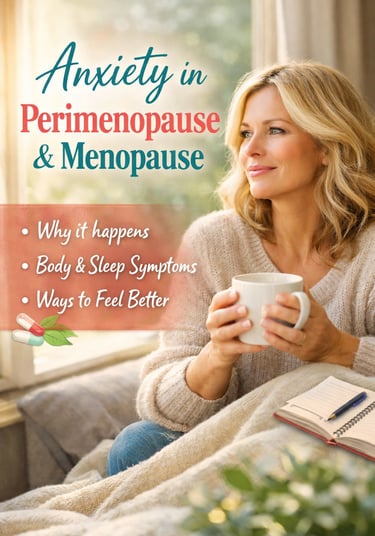
Why Anxiety Gets Worse in Perimenopause & Menopause (And What Actually Helps)
If you’ve been thinking, “Why am I suddenly anxious? I used to handle life better,” I want you to breathe with me for a second.
Because this is so common in perimenopause and menopause. And no — it doesn’t mean you’re “too sensitive,” “losing it,” or “getting weaker.”
I wrote this after doing what many of us do at 2 a.m.: searching everything, reading medical sources, and yes — asking doctors the annoying, detailed questions. What I learned is reassuring:
Most of the time, menopause-related anxiety isn’t one single cause. It’s a stack of factors that build on each other — and once you see the pattern, you can break it.
Quick note: This article is educational and supportive, not medical advice. If your symptoms feel severe, scary, or new for you, please talk to a clinician — you deserve real support.
Table of contents
Perimenopause vs menopause (quick clarity)
The “anxiety bundle”: why it happens
Why you may feel anxiety in your body first
The sleep connection (the hidden driver)
The 7-day observation checklist
The symptom diary (copy/paste table)
A practical 4-week calm plan
When to see a doctor (and what to say)
FAQ
1) Perimenopause vs menopause (quick clarity)
Perimenopause is the transition phase before menopause. Hormones don’t just “drop” — they fluctuate, sometimes wildly. This phase can last years.
Menopause is officially when you’ve gone 12 months without a period.
A lot of women assume menopause anxiety starts after periods stop — but in reality, perimenopause is often the peak “wired and worried” season because of those hormone swings.
2) The “anxiety bundle”: why it happens (the real reasons)
Here’s the honest breakdown I wish someone had told me earlier:
Reason #1: Hormones can act like a volume knob on your stress response
During perimenopause, estrogen and progesterone can change quickly. These shifts can affect brain systems involved in mood regulation and stress sensitivity. Translation: you may feel less emotionally buffered than you used to — even if your life hasn’t changed much.
Reason #2: Your body creates sensations that mimic anxiety — and your brain panics
Many women get physical symptoms like:
heart palpitations (that “thump,” “flutter,” or sudden racing)
waves of heat or flushing
internal tremor, shakiness
dizziness or “off” balance
tight chest or throat
Your brain’s job is to keep you alive. So when the body sends “weird signals,” the brain sometimes labels them as danger. That triggers adrenaline… which intensifies the sensations.
That’s how a feedback loop begins:
symptom → worry → adrenaline → stronger symptom → more worry
Reason #3: Sleep disruption makes anxiety almost inevitable
Broken sleep (especially from night sweats, hot flashes, or frequent waking) can make your nervous system feel raw. Even a few nights in a row can change your tolerance for stress, noise, decision-making, and emotional load.
Reason #4: Midlife pressure is real (and it lands on a sensitive nervous system)
Perimenopause often overlaps with:
high responsibility years (family, work, caregiving)
body changes and self-image stress
relationship shifts
financial pressure
health concerns
So even if hormones started it, life can keep it going.
3) Why you may feel anxiety in your body first (and not as “thoughts”)
A lot of women tell me:
“I’m not anxious about anything — I just feel anxious.”
That’s an important clue.
This kind of anxiety often shows up as:
a buzz in the chest
feeling “on edge”
sudden dread with no story
heart racing after coffee, sugar, or poor sleep
waking up at 3–4 a.m. with alertness + worry
It’s not “in your imagination.” It’s your nervous system running hot.
4) The sleep connection (the hidden driver)
If you only change one thing first, make it sleep protection.
Because when sleep improves:
your baseline cortisol/stress response often calms down
palpitations can feel less intense
your tolerance rises (you stop feeling “thin-skinned”)
mood steadies faster than you expect
You don’t need perfect sleep. You need less broken sleep.
5) The 7-Day Observation Checklist (this is your “pattern finder”)
Do this for one week. No judgment — just data.
Each day, quickly note:
Symptoms
☐ Anxiety level (0–10)
☐ Sleep quality (0–10)
☐ Night sweats/hot flashes (none / mild / moderate / strong)
☐ Palpitations (none / mild / strong)
☐ Mood (calm / irritable / sad / “wired”)
Triggers
☐ Coffee/caffeine (how much + what time)
☐ Alcohol (yes/no)
☐ Sugar/high-carb snack (yes/no)
☐ Overheating (hot shower, warm room, layers)
☐ Stress spike (argument, deadline, bad news)
What helped
☐ Cooling the room/body
☐ Protein + fiber meal
☐ Walk / movement
☐ Breathing (3–5 minutes)
☐ Magnesium / supplements (if you use them)
☐ Talking to someone / journaling
What you’re looking for:
Patterns like “anxiety spikes after poor sleep,” or “palpitations after coffee,” or “night sweats → next-day irritability.”
6) Symptom Diary Table (copy/paste)
You can paste this into Notes / Google Docs.
DateSleep (hrs)Sleep Quality 0–10Hot Flashes/Night SweatsAnxiety 0–10PalpitationsCaffeine (time)AlcoholFood notes (sugar?)Stress level 0–10What helped
If you fill this for 7–14 days, you’ll walk into any appointment with gold-standard clarity.
7) A Practical 4-Week Calm Plan (no perfection required)
This is the plan I’d give a friend who’s exhausted and just wants relief.
Week 1: “Stop the fire”
Goal: calm the nervous system and reduce spikes.
Caffeine test: keep it to morning only, or pause for 7 days.
Cooling sleep setup: cooler room, lighter bedding, breathable sleepwear.
Micro-breathing reset: 3 minutes, once midday + once before bed.
Try: inhale 4 seconds, exhale 6 seconds, repeat.Protein-first breakfast: even a simple one. This reduces blood-sugar swings that can feel like anxiety.
Week 2: “Stabilize blood sugar + energy”
Goal: fewer internal rollercoasters.
Build meals around: protein + fiber + healthy fat
Add a 10–20 minute walk after one meal (especially dinner)
If you snack, choose something stabilizing (yogurt, nuts, cottage cheese, eggs, tuna, etc.)
Week 3: “Move for nervous system regulation”
Goal: lower baseline anxiety.
4–5 walks/week (20–30 min)
2 short strength sessions/week (15–25 min)
Strength training helps mood, body confidence, and sleep — and it’s one of the most underrated supports in midlife.
Week 4: “Mind loop reset”
Goal: break the symptom→fear loop.
Use this simple script when symptoms hit:
Name it: “This feels like perimenopause anxiety.”
Anchor: “My body is activated, not endangered.”
Do the one thing that helps: cool down / breathing / short walk / hydrate
It sounds almost too simple — but it stops your brain from turning sensations into catastrophe.
8) When to see a doctor (and what to say)
Please don’t white-knuckle this alone.
Get urgent medical help if you have:
chest pain/pressure, fainting, severe shortness of breath
new severe palpitations with dizziness or weakness
thoughts of harming yourself
Make an appointment if:
anxiety is daily and interfering with life
sleep is consistently broken
palpitations feel frequent or scary
bleeding is unusual, heavy, or occurs after menopause is established
What to say (so you’re taken seriously)
Try this structure:
“These are my symptoms” (anxiety, sleep disruption, hot flashes, palpitations, cycle changes)
“This is how it affects my life” (work, relationships, functioning)
“I want to discuss options” (lifestyle, therapy/CBT, medication, hormone therapy if appropriate)
Bring your 7–14 day diary table — it changes everything.
9) FAQ (the questions everyone asks at 2 a.m.)
“Can perimenopause anxiety happen even if my periods are still regular?”
Yes. For many women, anxiety starts during the transition years — sometimes before cycles get clearly irregular.
“Why do I wake up anxious at 3–4 a.m.?”
Often it’s a mix of sleep fragmentation, temperature shifts, stress hormones, and your brain snapping into alert mode. Protecting sleep + cooling + steady evening meals helps.
“Are heart palpitations normal in menopause?”
They’re common, but “common” doesn’t mean you should ignore them — especially if they’re new, intense, or come with dizziness/chest pain. A clinician can rule out other causes.
“What if my doctor says ‘it’s just stress’?”
You can say:
“I understand stress is part of it, but these symptoms started alongside perimenopause changes. I’d like to rule out medical causes and discuss targeted support.”
“Do I need hormone therapy?”
That’s a personal medical decision. Some women benefit greatly, others use non-hormonal strategies. The best next step is a symptom-based discussion with a clinician.
Final reassurance (the thing I want you to remember)
If you’re feeling anxious in perimenopause or menopause, you’re not broken.
You’re in a biological transition, often with disrupted sleep, a more sensitive stress system, and real physical symptoms that can scare the brain.
And the good news is: once you stabilize sleep, reduce triggers, support your body, and get appropriate medical guidance when needed — this gets better.